Monday, March 30, 2009

Currently ...

Listening ToI don't wanna be kept,
I don't wanna be caged,
I don't wanna be damned, oh hell.
I don't wanna be broke,
I don't wanna be saved,
I don't wanna be S.O.L.
Give me rolling hills, so tonight can be the night,
that I stand among a thousand thrills.
Mister cut me some slack,
cause I don't wanna go back,
I want a new day and age!
- Neon Tiger, The Killers

Too Bad, So Sad

They should stay in jail. End of story IMO.

Sunday, March 29, 2009

With Oklahoma getting destroyed at the half ...

... against the Tar Holes, this report doesn't bode well for me.
"The emotional stress of loss and/or the intensity of a game played in a high profile rivalry such as the Super Bowl can trigger total and cardiovascular deaths," said Dr. Robert Kloner, a professor of medicine at the University of Southern California, who presented the study at the American College of Cardiology scientific meeting in Orlando.
I can certainly say that Oklahoma is certainly trying its best to give me a heart attack right about now.

Friday, March 27, 2009

When I hear the words "baby butter" ...

... I think I throw up in my mouth a little bit. But, I guess it might turn out to be a pretty good skin healing agent.
When they rubbed this white cream on mice missing a patch of their outer skin, the mice healed three times faster than untreated ones, Bouwstra says.

Tracking asteroids ...

Asteroid tracked in space, right down to Sudanese desert.
As 2008 TC3 hurtled through space, researchers studied the spectra of sunlight reflected from its surface to get information about the asteroid’s mineral composition. The spectra showed that the asteroid was likely to come from the mysterious F-class of asteroids, a class only observed in space but not yet found as a meteorite on Earth..

Monitoring 2008 TC3’s progress, researchers correctly predicted that it would impact the Nubian Desert of northern Sudan about 19 hours after it was first spotted. Eyewitnesses reported seeing a fireball as the asteroid exploded over the desert.

Jenniskens and 45 students and staff from the University of Khartoum in Sudan searched for remnants along the asteroid’s projected path. The recovery team eventually found about 47 meteorites from 2008 TC3.

Thursday, March 26, 2009

Good racquetball advice ... no back walls

No back walls.

My racquetball game is slowly improving, though I still have a tendency to keep the ball up. This gets me into trouble more often than not, and while I can rely on my speed to get to quite a few "passing" shots ... it's impossible to recover kill shots. And those kill shots happen when you give your opponent a nice high return.

So, keep your returns low, and avoid that back wall!

ASU doesn't seem to care ...

... about the fact that for a million dollars, they can keep a department which will churn out jobs which pay ~$50K to start in a field which has a national average vacany rate of 10.4% (in other words, every individual who obtains certification would most likely find a job immediately). Nope, they don't care about that. Perhaps they'll dump the program off on the local hospital system instead.
Due to space constraints on the Tempe campus, and because of the applied nature of the degree, consideration was given over the past few years to incorporating the program into the Phoenix Biomedical campus or relocating it to the Polytechnic campus. However, it was assessed that such plans would require more than $1,000,000 in new laboratory construction and/facility renovation in order to adequately administer the program to undergraduate students on either campus. Like other states with similar programs, funding from local hospitals could subsidize the continuation of the program and this idea is being examined.
Sheesh.

I do want to point this out though ... the commenter on my last post on this topic hit the nail right on the head IMO:
The loss of this program would be a detriment to the school and the community especially as this is the last accredited program in the state of Arizona. I will admit that the program has a high cost per student when compared to some degrees however I think that cost must be balanced by the good it will provide the community. After all this is a state university and it main purpose is not to make money but to provide and produce the educated workforce the state so desperately needs.
To me, this seems that the state should step in and demand that the Med Tech program remain open. IIRC, Oklahoma (where I used to live) didn't have a Med Tech program at any of the universities within the state and they were always suffering huge Med Tech shortages.

Why would Arizona take a play out of the playbook of a state which has chronic shortages of critical health care workers?

Tuesday, March 24, 2009

Currently ...

Listening To
Too heavy too light
Too black or too white
Too wrong or too right
Today or tonite ... cumbersome

Monday, March 23, 2009

Twits tweet on twitter ...

... as for the rest of us, who needs the headache?

Friday, March 20, 2009

An Open Letter to President Obama


Dear Mr. President,

A day or two ago I blogged about how you had irked Coach K of Duke. That was amusing. This latest episode on the Jay Leno show ... not so much. Listen, think before you speak. Or better yet, just do your job ... please. Because it's obvious that your Secretary of the Treasury isn't really doing his, and the Senators on the Hill aren't doing theirs (they're certainly not reading any of the legislation they're passing). So, that leaves you ... you whom we recently elected. Remember the adage: It is better to remain silent and be thought a fool, than to open your mouth and remove all doubt. You were the last person I would have suspected of saying something so incredibly dumb. Guess that showed me.

Giving up hope that anyone in charge is competent,
Thomas Joseph

PS: Check out these two links.

1. Special Olympics Press Release on your stupid comment.
2. Special Olympics campaign to end the hate.

Thursday, March 19, 2009

Awesome

I love stories like this one.

How much more secure can you get ...

... than a damn island? Moving the research performed on Plum Island onto the mainland is, IMO, a big mistake. This one blurb highlights why:
And in 1978, a foot-and-mouth outbreak occurred among animals in pens outside the laboratory.
Yes, and they were contained to the island. If that happened in Kansas, forget it ... you now have foot-and-mouth disease in the United States. The last outbreak in the US occured in ... 1914. To clear up that mess, it cost us 4.5 million. I'm not even going to bother converting that to today's dollar equivalent. It's one of the reasons foot-and-mouth disease is done on Plum Island, and not on the mainland. I hope I don't sit here years from now and blog "Told ya so, ya idiots."

Desalination

Listen up folks, you've read it here before (myself and commenters both), and I'll say it again. Fresh water is one of the scarcest resources on the planet. Here is an article on desalination techniques in Scientific American. It's a good read.
Almost three quarters of Earth's surface is covered with water, but most of it is too salty to drink. And the 2.5 percent that is freshwater is locked up either in soil, remote snowpacks and glaciers or in deep aquifers. That leaves less than 1 percent of all freshwater for humans and animals to drink and for farmers to use to raise crops—and that remnant is shrinking as rising global temperatures trigger more droughts. The upshot: it's becoming increasingly difficult to slake the world's thirst as the population grows and water supplies dwindle. Analysts at the investment bank Goldman Sachs estimate that worldwide water use doubles every 20 years.

New bacterial species identified ...

... nothing really exciting there, as new bacterial species are being identified all the time. Heck, there is an entire journal devoted to publishing on new bacterial species. How they were identified is fairly cool though.
The experiment was conducted using a 26.7 million cubic feet balloon carrying a 459 kg scientific payload soaked in 38 kg of liquid Neon, which was flown from the National Balloon Facility in Hyderabad, operated by the Tata Institute of Fundamental Research (TIFR). The payload consisted of a cryosampler containing sixteen evacuated and sterilised stainless steel probes. Throughout the flight, the probes remained immersed in liquid Neon to create a cryopump effect. These cylinders, after collecting air samples from different heights ranging from 20 km to 41 km, were parachuted down and safely retrieved.
Send a balloon up into the atmosphere, sample the rarefied air and drop samples back down to earth.

As for the three new species, they were named as follows:
One of the new species has been named as Janibacter hoylei, after the Distinguished Astrophysicist Fred Hoyle, the second as Bacillus isronensis recognising the contribution of ISRO in the balloon experiments which led to its discovery and the third as Bacillus aryabhata after India’s celebrated ancient astronomer Aryabhata and also the first satellite of ISRO.

Someone's not an Obama fan ...

Somebody said that we're not in President Obama's Final Four, and as much as I respect what he's doing, really, the economy is something that he should focus on, probably more than the brackets. - Duke coach Mike Krzyzewski

Tuesday, March 17, 2009

Cow Power

Article in USA Today.
Farmers in the Cow Power program still pay for the electricity they use on the farm. But they produce more than they use, and they sell what they produce to the electric company for 95% of the wholesale price plus 4 cents per kilowatt-hour. The St. Pierres calculate that they'll gross $200,000 a year on the sales.
Might we come to a point where farmers are more focused on converting animal waste than they are on the animals themselves? Of course, this is a great way for farms to remain profitable. Feeding animals is no cheap endeavor ... they're as hard hit by the prices of food as we are, and cows and hogs eat a lot more than us as well. Combine that with a consumers demand that food be cheap, and they're hit doubly so ... high feed prices combined with a demand that they sell their product at low cost. The two are diametrical opposites. That is, they were ... but perhaps converting the waste (which also resulted in a cost to house/treat) into energy converts that cost into revenue.

Monday, March 16, 2009

Garbage, garbage everywhere ...

ResearchBlogging.orgI don't know, I guess I'm a sucker for poor defenseless animals, and I guess I believe that we, as humans, should hold ourselves to a higher accountability when it comes to being proper stewards of our great planet Earth. So when I come across manuscripts like this one ... damn it, it pisses me off! Here is the abstract:
The leatherback, Dermochelys coriacea, is a large sea turtle that feeds primarily on jellyfish. Floating plastic garbage could be mistaken for such prey. Autopsy records of 408 leatherback turtles, spanning 123 years (1885–2007), were studied for the presence or absence of plastic in the GI tract. Plastic was reported in 34% of these cases. If only cases from our first report (1968) of plastic were considered, the figure was 37%. Blockage of the gut by plastic was mentioned in some accounts. These findings are discussed in the context of removal of top predators from poorly understood food chains.
Check out the following figure ...Whiskey Tango Foxtrot folks! Look at 1950 and on. That's all us ... humans ... contributing to these incident rates. What part of "Do not throw your trash in the ocean" can't people seem to understand? The authors have a pretty sobering point as well when they state:
Looking further ahead, we do not know what impact, if any, an increased demand for jellyfish by Asian markets could have on leatherback turtles. It has been speculated that leatherbacks off the coast of France take in more plastic in cooler months when jellyfish are scarcer. If it is correct that commercial harvests of jellyfish reduce the availability of this prey item, will ingestion of plastic by leatherbacks increase?
One can only hope not.

Reference
Mrosovsky, N., Ryan, G., & James, M. (2009). Leatherback turtles: The menace of plastic Marine Pollution Bulletin, 58 (2), 287-289 DOI: 10.1016/j.marpolbul.2008.10.018

The Spider Rifle

Found this coolness on the web.

Complements of Make:

Save the Tiger, Power the Village

Sorry for my lame Heroes allusion. At any rate, found this article in New Scientist interesting. The article is actually a small blurb on a manuscript (Arxiv) submitted for review entitled The Tiger and the Sun: Solar Power Plants and Wildlife Sanctuaries by Michael McGuigan of Brookhaven National Laboratory. I've never had a title that cool. His manuscript concludes with the following:
One difficulty with wildlife conservation is that it that it is often tied to human problems. This is because most of the wildlife is located near poor rural populations as those areas have less habitat destruction. One has to make a choice as resources are limited. Ultimately one has to help the human population.

An advantage of the integrated approach is that it ties wildlife conservation to a human solution, one which must be urgently implemented. The solar energy infrastructure must surely be secured due to its strategic importance. This security extended to the integrated wildlife sanctuary within, solves on the main costs how to maintain security over a 30,000 square mile reserve. Thus in this approach one helps the wildlife as well as the human population.
Seems like a simple enough approach, though financially I'm not sure how possible it's going to be in the short term ... or even the long term.

Is it only a matter of time before ...

... we have the flux capacitor?

Electrostatic capacitors.
Electrostatic capacitors store charge on the surface of two conducting plates separated by an insulating layer. Their advantage is that they can store and release energy much faster than batteries.

That makes them ideal candidates to replace batteries in devices that require speedy discharge of power, such as electric cars. However, electric capacitors can hold only limited charge. Supercapacitors that store charge chemically as well as electrically have greater capacities, but perform only as well as the best batteries.

Now a prototype capacitor has been made that manages to store power as densely as a supercapacitor, but deliver it at speeds comparable with electrostatic capacitors.

My Bracket

Wednesday, March 11, 2009

Big Time (Expert)?

A few days ago I received my first unsolicited email asking me to consider them for a postdoc position in my lab. They were asking because, according to them, I'm an expert in the field of bacteria pathogens.

Of course I don't directly work with pathogens any longer, it's more of an environmental microbiology gig, and I don't work in the field they'd like to, even though if you looked at my most recent published manuscript you wouldn't know it (unless you knew the entire sordid history of the project). And, of course, I don't have the funds right now to hire a postdoc either. Each year our agency provides money to researchers (it's a competitive process) to fund a 2 year postdoc, and I wasn't one of them (most directly because I didn't apply) ... heck, I've only been here a handful of years, I didn't want/need that additional stress while I'm working my way up for tenure.

If I did have the funds, I'd hire the postdoc requester ... if for no other reason they made my day. Plus, they've probably read at least one or two of my manuscripts!

Tuesday, March 10, 2009

Incommunicado

Manuscript craziness: Just had one published, waiting on the peer review results of another, and I'm in the process of analyzing data and putting together my first manuscript of the new year. Have another (plus a review) nipping at my heels as well. So I sort of have to play catchup. I'll be back, but first I need to put this introduction together.

I hate writing introductions.

Currently ...

Listening To

Great Angry Owl

Owl in Bangor, Maine isn't happy with nighttime skiers.
Over the past three weeks, at least eight skiers and a few romping dogs apparently have fallen victim to a great horned owl that swoops down from a tree with talons outstretched and smacks them on the head.
At least that's the only thing it's doing.

Thursday, March 05, 2009

What happens when the United States ...

... finds itself without any natural resources that are needed in a world economy? For example, a majority of the lithium needed for lithium batteries for electric cars can be found in Bolivia. In addition, Bolivia has wizened up and wants to use their resources to generate jobs (and profits) within their own country.
For Bolivians, economic development and job creation are a must — the partner can't be like foreign companies who they say shortchanged the nation's hardscrabble Indians while extracting copper, silver and tin from vegetation-starved highlands. Morales wants lithium batteries manufactured domestically, and even hopes to assemble battery-powered cars.
So, where does this leave the United States, who was hoping to factor in the environmentally-friendly car economy of the future? Exactly what natural resources does the United States have which can ensure that it remains a "power" in the future? Also, and I think more importantly, this points the focus towards recycling efforts. There are finite supplies of materials such as lithium in the world, so recycling them will be essential in the future. Since we are a consumer economy, the influx of these resources will be into the United States. Recycling ensures that they will remain here, and if they remain here we do not need to import (and thereby pay another country for the "rights" to these materials). Right?

I'm sure there are some flaws, or unnecessary worrying on my part, here ... so if someone can point them out I'd be appreciative.

More on ...

... Geothermal Power.
Two recent reports, among others, suggest that geothermal may actually be cheaper than every other source, including coal.
Of course ...
That does not mean companies are rushing to build geothermal plants: There are a number of assumptions in the geothermal figure. First, there are the tax incentives, which save about 1.9 cents per kilowatt-hour. Those won't necessarily last forever, however—although the stimulus bill extended them through 2013.

Second, the Credit Suisse analysis relied on what is called the "levelized [sic] cost of energy," or the total cost to produce a given unit of energy. Embedded within this figure is an assumption that the money to build a new geothermal plant is available at reasonable interest rates—on the order of 8 percent.

In today's economic climate, that just isn't the case. "In general, there is financing out there for geothermal, but it's difficult to get and it's expensive," Geothermal Energy Association director Karl Gawell told ScientificAmerican.com recently. "You have to have a really premium project to get even credit card interest rates."

That means very high up-front costs. As a result, companies are more likely to spend money on things with lower front-end costs, like natural gas–powered plants, which are cheap to build but relatively expensive to operate because of the cost of the fuel needed to run them.
It's a good, informative read. Check it out.

In the meantime, I'm off to analyze some data and write up another manuscript. No rest for the weary!

Presentation Etiquette - Avoid the Horribleness

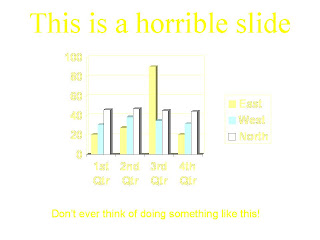
This blog entry over at Blue Lab Coats got me thinking that it was time to put together a "Presentation Etiquette" entry of my own. So here it is.

You see that picture above? I can't begin to tell you how many times I've seen something JUST. LIKE. THAT. Or better yet, the slides with the black background and the dark blue typing (or vice versa). You can't see a damn thing without seriously straining your eyes, and by the time you've gotten them to focus, the slide goes away only to be replaced with another monstrosity. Sometimes I think that some presenters either: don't check what their slides actually look like when in full presentation mode; don't want to give a talk so figure that the worst possible presentation will get them banned from the "lecture circuit"; are massively color blind; are afraid of people finding the flaws in their thinking/data; all of the above.

If you're going to give a presentation, it's a simple enough exercise to ensure that the slides are easily viewable to your audience. Proper color schemes, proper font usage, proper textual prompting, proper use of images ... it's not that hard to achieve. So, here are some pointers that I picked up along the way and will now pass on (quite a few can be found in the comments section of the blog entry cited above).

1. Make sure your font can be read against your background. Yellow lettering on a white background, or dark blue on a black background IS NOT VISIBLE. You can either go with a dark background with light coloring, or switch it around. A simple design such as a white background with black lettering is perfectly acceptable. It sends a "Hey, I'm only concerned about the data, you should be too." approach, and people won't be distracted. Having pictures in the background can get annoying (not to mention distracting) as well, and if you MUST have a picture in the background, make sure it doesn't obscure your lettering. I mean, a picture of a snowstorm and then using white lettering is going to be a total mess. And please, please, please ... if you use a picture as a background, use only one and stick with it! This is not a slideshow your latest vacation. For me, I go with a nice dark gray background with a light blue/beige lettering (see below).For me, I chose the dark gray background, and a pastel blue colored font for titles, and a beige colored font for text. If I need to really highlight a point, I go with a pastel red font for those points. These colors give me nice contrast without being disruptive and they're very easy to read (at least everyone I've discussed my slides with have said so). Plus, my schema is out of the ordinary (no one else I know uses this format) so I have managed to maintain some individuality for my presentations (especially when you're in a long line of presenters at a conference).

2. Serif font should be reserved for titles only. Serif font attracts the eye, causing one to spend more time reading it than sans serif font. Unless you want people to read your slides and not pay attention to you, leave serif fonts for the title of your slide only.

The above slide of mine is my title slide, so everything is in serif font. When I move to my next slide, the title is serif (Times New Roman) and the rest is sans serif (Arial).

3. Bullet points are not entire paragraphs. Bullet points are there to JOG YOUR MEMORY as to what you need to say/convey to your audience. It’s not there to be read by them.

This is one point that I think most people don't consider when they're putting their slides together. They get the impression that the slides are for those sitting in the audience. Well, that's really only half the case. The people are there to LISTEN. TO. YOU. They are NOT THERE to READ SLIDES. Now, the slides are important for the seminar attendee because when you show the data, it is easier for them to comprehend is visually (like when you're showing a gel, it's easier to point out the bands rather than say "Well, in lane 1 we had a band of 1,500 bp, whereas in lane 2 is was 2,000 bp.") Just show the gel and they'll instantly recognize the differences. However, the text ... that's there to help jog your memory (by listing only the highlights of that particular data set) so you can then explain it to the audience.

4. Please, do not read your seminar slides word for word to the audience. They can read if they want, but they are there to listen to you speak to them about a topic. Images are worth a 1,000 words, and they help you better convey your ideas anyways.

This is an extension of the above point. If your slide is all text, no one is going to pay attention to you. If you have full sentences, by and large (99.9% of the time I'd say), you have too much text on your slide. Condense it to a bullet point or two.

5. Uhhhh, ahhhh, ummm and other time filling utterings are annoying. If you say “As you can see …” during every slide, it’s going to piss people off. OF COURSE THEY CAN SEE, you don’t need to say it 30 times in a talk. Uhh’s and umm’s are just as distracting. If you’re going to give a talk, when you switch to the next slide, take a deep breath, think of what you want to say (because you’ve already prompted yourself with your bullet points) and THEN AND ONLY THEN, launch into the discussion of that slide. This pause gives your brain time to catch up with your mouth.

Obviously this has less to do with your slides than with you as a presenter. Those verbal ticks can drive people crazy. It's not too long ago that the press got on Caroline Kennedy for all of her "you know" utterances during her press talks. Besides, who hasn't counted the "ahh's" and "uhh's" and "umm's" during a particularly bad seminar? If you have, then you should know damn well that if you do it, chances are someone is running a tally on you.

SLOW. DOWN.

Remember that you are the expert in this area. If you are presenting data, you're probably the first person EVER to observe it. Come across that way.

So, those are a few of my tips on how to give a good seminar. I don't always get my seminars perfect (I wish I could), especially when it comes to point #5, but practice makes perfect. Going over your seminar several times, as tedious as it may be, will help you give a better seminar. Just don't make it too rehearsed. If you memorize your talk you run the risk of getting thrown off track and struggling for a slide or two if you get interrupted.

Anyways, any comments? Did I miss anything?

Wednesday, March 04, 2009

Currently ...

Listening To

Monday, March 02, 2009

Brought to Life

The Science Museum is a museum in England, founded in 1857. They have a multitude of interesting exhibits, some of which are online, like the following one: Exploring the History of Medicine. This exhibit has, on display (and online), a number of objects throughout the course of "modern" medicine. Never knew what an eye massager looked like? Now you can find out.

Saturday, February 28, 2009

Black History Month


In honor of Black History Month, I give you one of the preeminent biochemists of the 20th century, Percy Julian. Born in 1899, he received his Ph.D. at the University of Vienna. He passed away in 1975.
His biomedical research made it possible to synthetically produce large quantities of cortisone for the treatment of rheumatoid arthritis and other inflammatory conditions. His synthesis of cortisone reduced the price from hundreds of dollars per drop for natural cortisone to a few cents per gram.
His story is one of dedication: to one's ideals and to one's dreams. If you believe you can, find a way to do so. Percy Julian did.

Friday, February 27, 2009

New medical disorder identified

Playstation palmar hidradentitis. I kid you not.
Called "PlayStation palmar hidradentitis" by the scientists, the skin disorder can cause painful lesions on the palms similar to patches found on the soles of children's feet after taking part in heavy physical activity, they said.
Sign of the times?

Kelp Car

From Toyota.
The kelp car would build upon the already hypergreen 1/X plug-in hybrid concept, which weighs 926 pounds, by replacing its carbon-fiber body with plastic derived from seaweed. As wild as it might sound, bioplastics are becoming increasingly common and Toyota thinks it's only a matter of time before automakers use them to build cars.
Coolness.

Monday, February 23, 2009

Victory for self-harvested stem cells?

Stem Cell therapy cure for MS?
Edwin McClure, a Virginia Commonwealth University advertising graduate student, says a stem-cell study he participated in appears to have cured his multiple sclerosis symptoms.
Here is another link to a similar study.
Not one of 21 adults with relapsing-remitting MS who had stem cells transplanted from their own bone marrow deteriorated over three years.
Do No Harm - Coalition of Americans for Research Ethics

ASM 2009

Well I found out today the "disposition of my ASM abstract". Looks like I'll need to stay for pretty much the entire meeting because my poster session is towards the end. Certainly not the worst thing to happen to me, though I was sort of hoping that I could get in there, hit the sessions I needed to, give my presentation, and then boogie on home. Since it's in Philly, a place I've actually never been ... even though I grew up in that general area ... I guess I can spend a bit of time sight-seeing as well. Anyone know of some really good places to eat (and visit) while I'm there?

Thursday, February 19, 2009

GreenWheel

Electric bike.
Under its current configuration, a bike powered solely by a single GreenWheel (front, rear or both wheel can be equipped with a GreenWheel) has an estimated range of 25 miles. Pedaling the bike doubles the range under electric power, provided the rider isn't traveling at the nearly top speed of 30 miles an hour. The bike can be charged by pedaling or by plugging it into the electric grid.
Coolness.

ASU closing Med Tech program in cuts to science courses

In this day and age, closing off a source of vital job training is silly. It's a crying shame when that closure comes at the hands of a supposed institute of higher learning, which I imagine Arizona State University fancies itself.

At any rate, received this email from the American Society of Clinical Pathologists (ASCP) today:
DON'T CLOSE THE DOOR ON LABORATORY EDUCATION

Nationwide Campaign to Save ASU's CLS/MT Program


Tell Board of Regents, University Leadership:
Don't Close ASU's Clinical Laboratory Sciences/Medical Technology Program
Arizona State, Others Closing Doors to Laboratory Education


ASCP urges all members of the laboratory team to help!
Take a few minutes to help halt the closure of Arizona State University's ASU's CLS/MT program: send a message that laboratory professionals are critical to the health care team and that the documented shortage of laboratory professionals is reason to keep training programs open!

Visit http://capwiz.com/ascpath/issues/alert/?alertid=12713266&type=CU
There are approximately 15,000 open positions for Medical Technologists in the United States. Some states, such as Oklahoma, don't have university Med Tech programs so it's not that Med Techs are being churned out in massive numbers. However, more students are getting certified as laboratory professionals through technical colleges and distance learning programs, like this one that offers online health science programs and degrees. The growing for-profit education sector accounts for some of the lack of interest by many health science departments in medical technologist programs. I'm not sure if ASU…. I'm not sure if ASU is the only Arizona school with a B.S. degree Med Tech program, however even if it were not ... closing it down is still a big mistake IMNSHO. If you think so too, click the link and send those emails out (actually the site does it for you, you just put in your information).

Don't eat that bird!

Doh! Too late.
A rare quail from the Philippines was photographed for the first time before being sold as food at a poultry market, experts say.

...

Scientists had suspected the species—listed as "data deficient" on the International Union for Conservation of Nature's 2008 Red List—was extinct.

Wednesday, February 18, 2009

Geothermal Power

Interesting article in Scientific American. It even has an economic link!

Hello Comet Lulin

Comet to pass by Earth next week.
On Monday at 10:43 p.m. EST, it will be 38 million miles from Earth, the closest it will ever get, according to Donald Yeomans, manager of NASA's Near Earth Object program.

Tuesday, February 17, 2009

There Can Be Only One!

In graduate school I used to sometimes go by the nickname "The Highlander". It wasn't a name I gave to myself, it was given to me ... I mean really, who gives themselves that sort of nickname? At any rate, I received that nickname because when I used to do transformations, sometimes I'd wind up with one colony ... which happened to contain the exact product I needed, or if I screened multiple clones they'd all fail except for one ... which happened to contain the exact product I needed. If it had happened once, no big deal ... but I seemed to have had a penchant for pulling that one clone trick multiple times.Nice to see I haven't lost my touch.

I'm not a big fan of Facebook ...

... and this won't help things at all. From their TOS:
"You hereby grant Facebook an irrevocable, perpetual, non-exclusive, transferable, fully paid, worldwide license (with the right to sublicense) to (a) use, copy, publish, stream, store, retain, publicly perform or display, transmit, scan, reformat, modify, edit, frame, translate, excerpt, adapt, create derivative works and distribute (through multiple tiers), any User Content you (i) Post on or in connection with the Facebook Service or the promotion thereof subject only to your privacy settings or (ii) enable a user to Post, including by offering a Share Link on your website and (b) to use your name, likeness and image for any purpose, including commercial or advertising, each of (a) and (b) on or in connection with the Facebook Service or the promotion thereof."
Bold emphasis mine. Of course, I really haven't looked at the Blogger and Google TOS lately either.

Funny

Friday, February 13, 2009

Does this hold ...

... for manuscript rejections as well?
But in a modern world, our hypersensitivity to rejection can have surprisingly destructive consequences. When we're socially or romantically excluded, even in seemingly insignificant ways, it can lead to a host of negative psychological and physical side effects. That includes everything from lower scores on intelligence tests to a weakened immune system and increased aggression ...
I know I want to strangle someone when I get a less than stellar review on one of my manuscripts.

Currently ...

Listening To
So give me something to believe
Cause I am living just to breathe
And I need something more
To keep on breathing for
So give me something to believe

Believe, The Bravery

Thursday, February 12, 2009

Neandertal Genome

The rough draft of the Neandertal genome has been released.
...the team has decoded 3.7 billion bases of Neandertal DNA from a bone of a female Neandertal fossil discovered in Vindija cave in Croatia. That DNA represents about 63 percent of the total Neandertal genome.
So, what have they found so far?
Analysis of the genome reveals that humans and Neandertals share genetic roots stretching back at least 830,000 years. Neandertals, the species Homo neandertalensis, were humans’ closest relatives, appearing about 300,000 years ago and living in Europe and parts of Asia until going extinct about 30,000 years ago.
That's just a glimpse. The article is a good read, go check it out.

Court Sez: No link between vaccines and autism

So anti-vaccine activists, get over it.
An attorney for the families did not respond immediately to a request for comment. But the head of one consumer group that questions vaccine safety, the National Vaccine Information Center, said the court's ruling will do little to change the minds of most parents who suspect a link between vaccines and autism. She said more studies are needed.
Exactly how many more studies are needed? It wouldn't matter how many studies were performed ... you'd always make the same claim: More studies are needed.

So, just shut up and get your kids vaccinated already.

Monday, February 09, 2009

No talking in class!

ResearchBlogging.orgFor all microbiologists not living in a cave, we all know that we're really losing the war against pathogenic bacteria, at least on the antibiotic front. Even the most potent antibiotics like vancomycin -- often considered the antibiotic of last resort -- have seen some organisms develop resistance to it. So, it's time for either new drugs, or a new approach. A New Scientist article discusses developing new antibiotics which target quorum sensing. The article is based on a communication in Chemical Communications, entitled: Towards quorum-quenching catalytic antibodies. The process of quorum sensing is described as following in the NS article:
Individual bacteria monitor the concentration of signalling molecules, and when it reaches a certain level, change their behaviour. That concentration provides a rough indication of when the number of cells in a particular population has reached a certain critical mass – known as a quorum.
So? This process, the authors hypothesize, can be targetted in what they call "antivirulence therapy".
Bacterial antivirulence therapies seek to avoid the development of treatment-induced resistance.
The NS article continues to explain:
But hacking the bacterial communication system could make it possible to prevent this transformation, and leave the cells waiting in a safe form for an attack signal that never comes. That would give the immune system extra time to naturally clear the bacteria from the body, says David Spring at the University of Cambridge, UK.
Of course, that does mean that the body needs to clear the infection on its own. In some circumstances, that may not be possible. But at any rate, how can they do it? They plan on designing antibodies to these quorum molecules. These antibodies will degrade the quorum molecules upon contact, or at least that is the hope/plan.

Reference
Prashant B. Kapadnis, Evan Hall, Madeleine Ramstedt, Warren R. J. D. Galloway, Martin Welch, David R. Spring (2009). Towards quorum-quenching catalytic antibodies Chemical Communications (5) DOI: 10.1039/b819819e

The Grammy's

I consider award shows a total waste of time. Waste. Of. Time. However, after watching Be Kind Rewind last night (Netflix rocks), I switched back over to the television and came across the Grammy's. So I decided to watch for a bit. I think I hit the Disney segment because both Miley Cyrus (can't stand her) and the Jonas Brothers (can't stand them) both did performances. However, I noticed something interesting ... it appears that Disney couldn't just get them up on stage to perform. Instead they actually had to have their acts chaperoned. Miley had to sit next to the much more talented Taylor Swift, and the Jonas Brothers had to act like fools next to Stevie Wonder. I hope both of these kidlet acts never succeed outside of Disney's purview.

Come on Denver!

Get with the program. It's a statue for crying out loud.
Alternate monikers suggested for the horse with the glowering eyes include "Bluecifer," "Satan's Steed" and "Blue Devil Horse."
Bluecifer. Heh.

When I saw the picture I thought it looked somewhat familiar, and wondered where I had seen something similar before. According to Wikipedia, Luis Jiménez, a sculptor was killed making this piece. Maybe the Bluecifer moniker is accurate after all. At any rate, it was based on a sculpting of his named Mesteño which is on display at my alma mater, Oklahoma. The one on the Oklahoma campus is just a wee bit smaller, coming in at approximately 8 feet in height (as compared to the 32 feet of the Denver airport sculpture). It's current location is outside OU's Fred Jones Jr. Museum of Art. There are pictures on flickr here (daytime) and here (nighttime). Why the nighttime shot? Take a look for yourself, and that's not photoshopped either.

Friday, February 06, 2009

Forward Contamination

Forward contamination is the passing of earth organisms to other space objects (of particular relevance, the Moon and Mars). The issue is discussed in Time Magazine.
Even though Phoenix was assembled in a special clean room to minimize bacterial contamination, and its arm, which would have direct contact with Martian ice, was heat-sterilized before launch, it's likely that dozens or more species of microbes hitched a ride on Phoenix's 10-month trip to Mars. Once on Mars, it's possible that bacteria shielded by the structure of the spacecraft from the harsh Martian UV radiation could stay alive, in dormancy, for hundreds of thousands of years. And if native microbes do exist on Mars — nothing has been found yet, but scientists hold out hope that the ice present on parts of the planet harbors life — there's a risk that foreign bacteria could contaminate or somehow change the development of their Martian counterparts.

The state of sustainable energy

New Scientist article.
Although scientists are agreed that we must cut carbon emissions from transport and electricity generation to prevent the globe's climate becoming hotter, and more unpredictable, the most advanced "renewable" technologies are too often based upon non-renewable resources, attendees heard.
Three cited examples are: 1. Iridium; 2. Platinum; 3. Land.

To everyone who has freaked out about the flu ...

... there is a reason to feel a bit more secure today.
Strep infections and not the flu virus itself may have killed most people during the 1918 influenza pandemic, which suggests some of the most dire predictions about a new pandemic may be exaggerated, U.S. researchers said on Thursday.
Yah, but ... something still killed those people.

Well, yes indeedy, but that something was a bacterium, and we now have antibiotics to treat bacterial infections, see?
"Neither antimicrobial drugs nor serum therapy was available for treatment in 1918," Klugman's team wrote.

Now there are also vaccines that protect against many different strains of S. pneumoniae, which cause infections from pneumonia to meningitis.
That's not to say that if you come down with a fever you should just pop whatever antibiotics you have in your bathroom cabinet ... since you should have finished your antibiotics for what they were prescribed for ... but there is no reason to panic about some massive flu epidemic which will wipe out 10% (or more) of the worlds population.

Wednesday, February 04, 2009

That's Doctor Thomas Joseph to you!

On occasion, the scientific blogosphere gets into a tizzy about some subject or another. This week it's about Dr. Biden wanting to be called ... well ... Dr. Biden. Go figure.
"My feeling is if you can't heal the sick, we don't call you doctor," said Bill Walsh, copy desk chief for the Washington Post's A section and the author of two language books.
Heh. O-tay!

At any rate lots, and lots, and lots, and lots, and lots, and lots (and I didn't get/list them all) of Science Bloggers are blogging about it, and most are miffed!

Honestly, at work and especially in my private life ... I don't expect to be called doctor. Heck, when I received my degree and called my family, my own mother didn't even call me Doctor (though the rest of my family tried it out on me at least once), so I was brought down to earth fairly quickly. My mom of course denies that she did it to avoid me having a big head, but rather to the fact that she was road-tripping with my sister at the time and was paying attention to the road (even though my sister was the one driving).

At any rate, I can see what upsets people about the dismissive comments by Bill Walsh ("Mr." left off purposely). I especially understand that it can be upsetting to women, who often have earned their degree while fighting opposition and derogatory/sexist behavior -- much tougher odds than their male counterparts. I think everyone who earns their Ph.D. should be proud of it, and they should use it if they are so inclined. As for me, there are times I'm referred to as Doctor (it's the work culture I'm in actually), but I don't make a point of using it. I do have business cards that have Ph.D. after my name (they're cool) and I have a business card holder inscribed with my full name (and making mention of the Dr. as well) but that comes out only in certain instances ... such as when I attend customer workshops and people are looking to me for my scientific expertise. More often than not, I prefer to be called Tom, and my support scientists were instructed very early to use that, and only that to get my attention. What they call me behind my back is another story, and I probably don't want to know.

So, what does all this boil down to? If you earned it, and you want to use it. Use it! If you don't, don't! It's your call either way. All this typing to say that, eh?

Oh, and if you're one of those people who refers to all female teachers as "Ms." and all male teachers as "Dr." ... stop and think about it. Heck, why don't you ask them what they'd like to be called? There's a shocker for ya!

In the future, Big Brother will go by one name ...

Google.
Google also is promising not to retain any information about its users' movements. Only the last location picked up by the tracking service will be stored on Google's computers, Lee said.
Suuuuurrrrreeeee.

Requiescat In Pace

Michael Dubruiel. He was a blogger, an author, and most importantly to him a loving and caring father and husband.

Tuesday, February 03, 2009

Change we can believe in?

WTF is with all these Democrats who can't seem to file their taxes properly?

This is getting disgusting. The rich keep getting richer, and the rest of us get screwed. Fun times!

Irony ...

... I learned long ago that when one opens their mouth to be a wise-ass, it often comes back to bite you in the ass. And Biden has a big mouth, which means that chomp will often be painful (to the ego at the very least).

Monday, February 02, 2009

Keyword of the Day

The Nuclear Option

Is Nuclear Power Worth It? Link goes to a Scientific American article. It's definitely worth the read. Definitely some pro's and con's to this energy source.

A pro, as odd it may seem by reading this quote:
And nuclear power plants have been operating in the U.S. for 50 years without exposing workers or residents in surrounding areas to excessive radiation. "Radiation is mundane, it's a weak carcinogen," says Rod Reed, a senior health physicist at the NRC. "It leads to very mundane changes, not three-eyed fish."

In fact, a typical coal-fired power plant exposes local residents to as many as 18 millirems of radiation yearly, whereas a nuclear power plant emits less than six millirems per annum, according to researchers at Oak Ridge National Laboratory.

Reed adds: "Radiation should be respected, not feared."
And a con?
At issue in the failure at Davis–Besse is the alloy metal used to craft the nozzles—known as Inconel 600 or Alloy 600. The alloy of nickel, chromium and iron is resistant to corrosion generally—but slowly cracks when exposed to boric acid and stress.

But it isn't just reactor heads that are made from the stuff. The steam generators that transfer the heat from the solution of water and boron, which comes into contact with the nuclear reactor, to the water heated into steam that turns the turbines to produce electricity also employ the alloy. "The tubes in the steam generators were susceptible to cracking," says Ken Karwoski, senior level advisor for steam generators and material inspection at the NRC's Office of Nuclear Reactor Regulation. "It's a combination of the temperature and the water chemistry."
So is this an issue dealing with all nuclear power plants? Fortunately no.
As early as the late 1950s there was some suggestion that this metal would crack under pressure but "the decision was made to go with this material," Karwoski says. "The perspective was that it should last but it didn't." And, as of today, there are still 15 nuclear power plants, including Davis–Besse, employing their old steam generators made from the alloy.

The U.S. fleet of 104 nuclear reactors—most built in the 1960s and 1970s—produced 806.5 billion kilowatt-hours of electricity in 2007, a record, and ran almost 92 percent of the time.
Speaking of issues with nuclear energy infrastructure, here is another article from Sci Am about nuclear mishaps.
In all, there were 10 incidents at U.S. nuclear plants last year [2006] that merited ratings of 2—"significant spread of contamination / overexposure of a worker" and "incidents with significant failures in safety provisions," as the INES handbook puts it—or above, Jones says. "Two reactor events and eight nonreactor events."
Overall, I'm still of the opinion that nuclear energy is a reasonable source of energy for the United States.

More on ...

... the new process to create LED lights.
The cost of production has kept the LEDs far from homes and offices, however. Gallium nitride cannot be grown on silicon like other solid-state electronic components because it shrinks at twice the rate of silicon as it cools. Crystals of GaN must be grown at 1000°C, so by the time a new LED made on silicon has cooled, it has already cracked, rendering the devices unusable.

One solution is to grow the LEDs on sapphire, which shrinks and cools at much the same rate as GaN. But the expense is too great to be commercially competitive.

Now Colin Humphreys's team at the University of Cambridge has discovered a simple solution to the shrinkage problem.

They included layers of aluminium gallium nitride in their LED design. These layers shrink at a much slower rate during cooling and help to counteract the fast-shrinkage of pure gallium nitride. These LEDs can be grown on silicon as so many other electronics components are. "They still work well as LEDs even with those extra layers inside," says Humphreys.

Currently ...

Listening To

Well, that's thanks for ya

Woman saves bosses life, only to be "downsized" a couple of months later.
The firing comes just months after Hegyi, a registered nurse, saved the life of station finance manager David Breed, who suffered a severe heart attack at work in September.

Sunday, February 01, 2009

Linkage

Astronomy
SEDS Messier Catalog
TUMOL - The Ultimate Messier Object Log (Software)
Stellarium - Open Source Planetarium (Software)
Astronomy POTD - NASA's Astronomy Picture of the Day

Microbiology
The Microbe Zoo

Gah!

I hate the Steelers. Arizona should have had that game wrapped up. Too many penalties and bad plays cost them.

I wonder if the Jets will ever make the Super Bowl again. In my lifetime would be nice.

Saturday, January 31, 2009

So ...

... what do people think of the new background? Yucky? Worth keeping? Needs a touch-up or two?

Friday, January 30, 2009

Cheaper LED's coming soon

LEDs now grown on silicone vs. sapphire wafers.
GaN, grown in labs on expensive sapphire wafers since the 1990s, can now be grown on silicon wafers. This lower cost method could mean cheap mass produced LEDs become widely available for lighting homes and offices in the next five years
Energy resources are going to improve in typically one of two ways. First is to find new sources of energy. Second is to find better ways to conserve. LEDs fall into the second category.

Thursday, January 29, 2009

First sign of the Apocalypse

Currently ...

Listening ToBest song on the album: Six Days (Soulwax Mix)

The song was originally sung by Colonel Bagshot back in 1971, under the title Six Day War, and was remixed by DJ Shadow in 2002.

Six Days
At the starting of the week
At summit talks you'll hear them speak
It's only Monday
Negotiations breaking down
See those leaders start to frown
It's sword and gun day

Tomorrow never comes until it's too late

You could be sitting taking lunch
The news will hit you like a punch
It's only Tuesday
You never thought we'd go to war
After all the things we saw
It's April Fools' day

Tomorrow never comes until it's too late

You hear a whistling overhead
Are you alive or are you dead?
It's only Thursday
You feel a shaking on the ground
A billion candles burn around
Is it your birthday?

Tomorrow never comes until it's too late
Make tomorrow come I think it's too late

Wednesday, January 28, 2009

Netbooks and Linux

This article makes no sense to me. Rather, the opinions of the users of netbooks, makes no sense to me.
“Linux just isn’t a platform for the mass market,” he said. “All the early reports of lots of returns of Linux netbooks were because people bought them with that and didn’t know what to do with it.”
Say again? What's so difficult about Linux? I have an Asus EEE Pc (900 model) which has Linux on it. It's a sweet little machine. 20GB flash drive, with an additional 16 GB in the SDHC slot that comes standard on the side (the 16GB SDHC card cost me ~$16 dollars from Amazon ... not a bad price to effectively double the memory of the machine). Oh, and I haven't had a single problem with it, especially when all I'm doing is surfing the net, or taking down quick notes with the Open Office software which comes installed. Yes, it take a bit of brain power to get full functionality, but it really does come with time and use.

Are people just lazy, or do they rely on "Windows for Dummies" books more than I realize?

How are you going to spend your ...

... extra five months?
Between 1978 and 2001, Americans’ average life span increased almost three years to 77, and as much as 4.8 months of that can be attributed to cleaner air, researchers from Brigham Young University and Harvard School of Public Health reported in Thursday’s New England Journal of Medicine.
I guess this means we'll all live longer, allowing us to see global warming armageddon. w00t!

Tuesday, January 27, 2009

You said it Jack Cafferty!

Stimulus package is loaded with crap. The link is mostly about how Limbaugh is a loud-mouth, but read the last paragraph.
The stimulus package is not going to be a walk in the park either. Republicans are yelling it's too costly and doesn't stimulate enough. And they might have point. It's at $825 billion now and could go higher. Hundreds of millions for condoms and other contraceptives doesn't belong in there either, unless it's for what's about to happen to the American taxpayer.
So ... who's ready for "what's about to happen"? I'm not.

Monday, January 26, 2009

Synthetic Biology

I'm not a Craig Venter fan, but you have to hand it to him, he's motivated and doesn't back down from a challenge. Here is a talk of his on his quest to create life. It's a 15 minute video. The organism he plans on creating is Mycoplasma laboratorium.

Currently ...

ReadingThe best portable star atlas in production (IMNSHO).

Listening To

Nuclear Power

I'm not sure that many people actually consider this, but ... nuclear power is going to be as finite as fossil fuels are. Current estimates peg nuclear power as being capable of powering the world at current rates for the next 200 years. Then, that's it folks.
According to the NEA, identified uranium resources total 5.5 million metric tons, and an additional 10.5 million metric tons remain undiscovered—a roughly 230-year supply at today's consumption rate in total.
There are a couple more options though ...
Two technologies could greatly extend the uranium supply itself. Neither is economical now, but both could be in the future if the price of uranium increases substantially. First, the extraction of uranium from seawater would make available 4.5 billion metric tons of uranium—a 60,000-year supply at present rates. Second, fuel-recycling fast-breeder reactors, which generate more fuel than they consume, would use less than 1 percent of the uranium needed for current LWRs. Breeder reactors could match today's nuclear output for 30,000 years using only the NEA-estimated supplies.
That's a bit more comforting. The question is ... would future developers actually develop these technologies sometime other than the 11th hour like we're currently experiencing with oil?

If you talk to someone in the know ...

... when it comes to environmental issues, and you ask them what the next "Big Deal" is, they'll tell you "Water". Water is a hot commodity, and we totally take it for granted. I mean, admit it ... you literally flush drinking-grade water down the toilet every day without even drinking it. I've blogged about it before. However, despite our cavalier attitude about water, it really is a finite resource. One only need look at Atlanta of last year to realize that, and farmers in California this year are going to be squeezed very tightly thanks to new regulations.

So? We need more water, and we need is yesterday. And scientists may have stumbled upon something which may help us achieve that goal. Desalination done cheaply, also an item I mentioned in that blog entry I linked to earlier in this entry.

National Food Poisoning Death Toll At Seven

Salmonella is to blame.
A seventh death was linked Friday to a nationwide outbreak of salmonella associated with tainted peanut butter and paste sourced to the Peanut Corp. of America's plant in Blakely, Ga., authorities confirmed.

Although their exact causes of death have not been determined, all seven people have died after being infected with the bacterial strain Salmonella Typhimurium, the Centers for Disease Control and Prevention said on its Web site.
Actually, it's Salmonella typhimurium (note capitalization/italicization), but who's counting?

At any rate, the USDA's Food Safety and Inspection Service (FSIS) agency has a FAQ sheet on salmonellosis. Here is a sample from the FAQ.
Q. What are the symptoms of salmonellosis?
A. Most people experience diarrhea, abdominal cramps, and fever within 8 to 72 hours after the contaminated food was eaten. Additional symptoms may be chills, headache, nausea, and vomiting. Symptoms usually disappear within 4 to 7 days. Many people with salmonellosis recover without treatment and may never see a doctor. However, Salmonella infections can be life-threatening especially for infants and young children, pregnant women and their unborn babies, and older adults, who are at a higher risk for foodborne illness, as are people with weakened immune systems (such as those with HIV/AIDS, cancer, diabetes, kidney disease, and transplant patients).
As you can see, it can be a nasty bug, especially those who do not have a strong immune system.

The FDA also has Salmonella listed in their "Bad Bug Book". According to the chapter on Salmonella, the infectious dose is only about 15 to 20 cells, so this is a very contagious organism.

Unfortunately, with this case in particular, give its ubiquitous nature (found in a variety of non-cook ready-to-eat food items) it's very hard to suggest a method to ensure that if you eat some of this food, what you can do to avoid getting sick. In this case, just avoid these items for the foreseeable future.

Wednesday, January 21, 2009

Currently ...

Listening ToU.N.K.L.E. - War Stories

Burn My Shadow
I have burned my tomorrow
And I stand inside today
At the edge of the future
And my dreams all fade away

I have burned my tomorrows
And I stand inside today
At the edge of the future
And my dreams all fade away

And burn my shadow away

Fate's my destroyer
I was ambushed by the light
And you judged me once for falling
This wounded heart will rise

And burn my shadow away

An' I see the light, too light for love

An' I see the light, too light for love
Burn my shadow
An' I see the light, too light for love
Oh...
An' I see the light, too light for love
Burn my shadow
An' I see the light, too light for love
Away

And burn my shadow away
Oh, how I loved you

Tuesday, January 20, 2009

Ok, now what?

According to this CNN article, we've finally come to the consensus that global warming is real.
Human-induced global warming is real, according to a recent U.S. survey based on the opinions of 3,146 scientists.
The study was produced by the University of Illinois and according to the article asked two major quesitons.
Two questions were key: Have mean global temperatures risen compared to pre-1800s levels, and has human activity been a significant factor in changing mean global temperatures?

About 90 percent of the scientists agreed with the first question and 82 percent the second.
A little late in the game if you ask me. We needed to be working on solutions years ago. It's also interesting to take note of who were the biggest doubters of global warming. Petroleum geologists and *drum roll* meteorologists.
Petroleum geologists and meteorologists were among the biggest doubters, with only 47 percent and 64 percent, respectively, believing in human involvement.
Heh. Meteorologists can't even get the short term weather correct, what makes anyone think they're reliable in the long term?

So ... now what? This really is an issue that needs to be addressed NOW. Enough with these questionnaires, and onto some solid, workable solutions.

For my part, I work on greenhouse gas emissions from agricultural waste, so attempting to understand the microbial involvement (which is rather large) and how we can curb it, will hopefully be my contribution.

Perhaps ...

... we should have children write any complaint letters we ever need to write.
"Dear Mr. Claudet," the letter from the 7-year-old girl began. She described in four sentences problems at Southdown West Park, the small greenspace by her home. The plastic slide needed to be more slippery, she wrote, and an electrical panel near the tennis court was "dangerus."

When she mailed the letter, little did she know that she would set the parish's bureaucratic wheels in motion.

All her requests for improvements were met during the holidays after the letter landed on Parish President Michel Claudet's desk. He opened it himself, he said, and took the young girl's input seriously.

Thursday, January 15, 2009

Edolphus Towns (D-NY) is a Moron

With all the problems our country is facing, you know what with the two wars we're fighting, an economy in shambles, the mortgaging of our future with almost a trillion dollars in bailout money with very little strings (or expectations) attached, this fool wants to hold hearings about the Bowl Championship Series because he doesn't think a "true #1" came out of the BCS.
"I think you really do not get a true No. 1 out of (the Bowl Championship Series)," Towns told the newspaper. "Nobody questions the Super Bowl. The team that wins is the best team that year. I think we can do the same thing at the college level where once it's over there is no questions about who is No. 1 and who is No. 2."
WHO CARES!?!?!!!!

This is all this fool can think about? Jimminy Christmas! Everyone who voted for this guy should be summarily slapped upside the head for picking such an obvious "winner".

At least someone speaks common sense at the end of the article though.
Former house Majority Leader Dick Gephardt of Missouri said he thinks Congress won't have time to deal with this issue with so many issues, particularly the economy, facing lawmakers. "I think this is something that colleges will have to figure out together," Gephardt told USA Today. "I'm not sure this is what the public wants Congress to be spending their time on."
And I repeat ...
I'm not sure this is what the public wants Congress to be spending their time on.
Damn Friggin Skippy!

So, while I think a playoff would be nice ... I don't think Congress should be wasting my tax payer dollars making it so. I can certainly live without a playoff. I cannot live without my government functioning properly and ensuring that the services I pay for actually work for me (now and when I retire).

So, Mr. Towns get your ass in gear and do something USEFUL and IMPORTANT! You damn fool.

I am not a number, I am a free man!

RIP Patrick McGoohan.

Tuesday, January 13, 2009

Currently

Listening ToCaravan is one of the best songs of all time.

Screwed

If you haven't accepted it yet, perhaps think about this one as well.
One of the nation’s largest health insurers has agreed to pay $50 million dollars in a settlement announced today after being accused of overcharging millions of Americans for health care.
How?
New York Attorney General Andrew Cuomo says Ingenix has been manipulating the numbers so insurance companies pay less. In a just-released report, he contends that Americans have been “under-reimbursed to the tune of at least hundreds of millions of dollars.” Although UnitedHealth Group and Oxford Insurance were the only entities investigated, other major insurers use Ingenix, including Aetna, CIGNA and WellPoint/Empire BlueCross BlueShield.
If you've been screwed, don't ever expect the screwer to say "Sorry".

Where I have been

I've visited 31 states (62%), and I've lived in 4 of them. Create your own visited map of The United States. I haven't been outside the United States (aside from Mexico and Canada) so I won't bother with that little meme. Oddly enough, I grew up in New York, and I've never bothered traveling up into New England.

h/t to Phil from DC Dispatches.

Anything but Normal, in Normal IL

Wedding in Taco Bell.
"We have the same brain, just in two bodies," Paul Brooks said.
No comment. Well, other than to say I guess that explains getting married in a "Toxic Hell". Having half a brain will do that to ya I suppose.

Lay off the VapoRub

So says new study.
The strong-smelling ointment often dabbed under noses or rubbed on the soles of feet can be an irritant, increasing the production of mucus and decreasing how fast it’s cleared, potentially causing dangerous breathing problems in infants and very young children.
I don't know why people even bother using that stuff. It stinks and it doesn't really do anything. If I'm feeling like crap, and I use Vicks ... I just wind up stinking AND feeling like crap.
Jessica Rosenberg, 32, of Santa Clara, Calif., said she rubs Vicks onto the soles of her kids’ feet to quiet nighttime coughs. The new study is interesting, she said, but not enough to make her stop.
What?!?!

Dear God. Why would rubbing menthol on your kids foot keep them from coughing? Idiocy abounds.

This urban legends site dispels the silly "menthol on feet is good for you" myth. Though this 1908 explanation is amusing, and so very very backward: "internal morbid processes may at times be relieved by creating external irritations". In other words, if you have a headache, hit your hand with a hammer. It'll make you forget all about the headache. Oh,the fun we could have with this one.

Friday, January 09, 2009

Requiescat In Pace

Reverend Richard John Neuhaus, editor of First Things.

I think ...

... I know how I'm going to make my money and get myself to early retirement. I'm going to steal a supertanker filled with Saudi oil.

Quote of the Day

Don't try to be happier than happy. - Colin Cowherd

As if there wasn't enough to worry about?

Now NASA is warning that solar storms could knock out a large portion of the world's electronics, and electrical infrastructure if we're really, really unlucky. And who can really claim to have good luck right about now?
Damage to power grids and other communications systems could be catastrophic, the scientists conclude, with effects leading to a potential loss of governmental control of the situation.
Hmm, if this happens perhaps that crazy Russian would be right. I don't really want to be a part of the EU though ... if they even still existed.

Thursday, January 08, 2009

Boomer Sooner!


Thrash the Gators!

Wednesday, January 07, 2009

Nifty Agricultural Tool

Was at a Soil and Water Conservation meeting earlier in the week and saw a talk on compost. This product was mentioned, and boy is it a neat idea. Gardensoxx. Just place it where you want it, cut a slit to insert your seeds and Viola! within a week, you have the starting of a garden. These soxx are multipurpose, used for erosion control, agriculture, gardening ... and relatively inexpensive when compared to what you'd pay for a garden's expenses anyways.

Five Ways the World Might End

Here's a really chipper story for the new year. Good news? None of these are predicted to happen tomorrow.

Friday, January 02, 2009

Linkage

Bureau of Communication

Funny stuff.

Currently ...

Listening To

Did You Make a New Years Resolution?

If it involves working out and/or losing weight, here is a handy tip chart for you. Me, I'm not into the whole resolution thing. I have been committed to losing a few extra pounds that I gained during graduate school, but I didn't feel the need to make a resolution on Jan 1st at 00:00:01 for it. I have found that losing the extra pounds can be done slowly but surely by two things. Exercise and portion control. No need for a fancy diet, or pay out the butt to have a company mail you food. Four to six ounces of meat at dinner along with a healthy salad and a generous helping of green vegetables works just fine.

If you're gonna go ...

... you might consider going in a National Park.
[At] least 33 people who chose to end their lives last year in a national park. The number is higher than recent years, although the National Park Service hasn't consistently tracked suicides.

"It's some place where, toward the end of someone's life, when they're feeling a total sense of despondency, they want to return to a place of natural beauty ... for their final moments," Suddath said.
Personally, I don't believe suicide is the answer. As they say, it's always darkest before the dawn. I truly believe that, and I hope I always will. Nevermind the terrible wake of psychological damage that is inflicted on those left behind.